Decay and Renewal
An ancient framework for understanding decline, awakening, and the age we live in

Everything falls apart.
Relationships, institutions, civilizations, ideas, nothing keeps its original form forever. We feel this instinctively. Decay rarely appears random. It moves in patterns. Renewal is not the opposite of decay, but its hidden continuation. One becomes the condition for the next.
The ancient Hindu idea of the Yugas maps this movement through four ages: Satya, Treta, Dvapara, and Kali. They are not merely spans of time, but stages in humanity’s relationship with truth — what the Vedic traditions called ṛta, the root of the word “right,” or what the Taoists simply called the Tao.
The movement is simple:
Truth remains.
Our ability to perceive it fades.
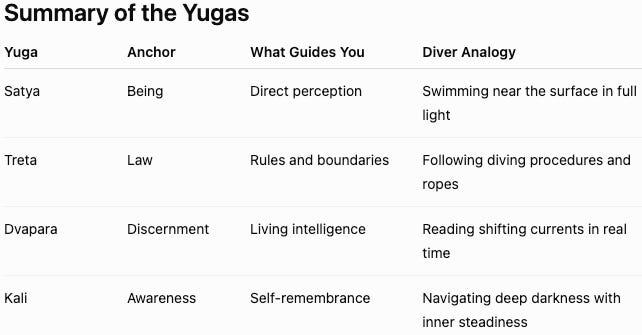
The entire cycle can be imagined as a diver descending into deeper waters.
At the surface, everything is visible. No instruments are needed. No maps. No rules. But as the diver descends, pressure increases, light weakens, and survival begins requiring external support. Eventually the diver reaches depths where even the instruments stop helping. At that point, only awareness remains.
The Yugas describe this descent.
Satya Yuga
In the beginning, truth is lived.
The diver is still near the surface. Light is everywhere. Orientation is effortless.
No rules are needed because there is no separation between seeing and being. A man with sight does not need a law instructing him not to walk through a wall. He sees directly.
This is the age of wholeness. Humanity still participates in reality rather than standing apart from it. Paradise before exile. Eden before knowledge divides the world into subject and object.
But eventually consciousness turns inward and asks:
“Who am I?”
And with that question comes distance.
Self and other emerge. Desire appears. Comparison appears. The seamless fabric begins to split.
Not as punishment, but as the price of individuality.
The diver begins descending.
Treta Yuga
When direct seeing weakens, rules become necessary.
The diver is now deeper underwater. Pressure increases. Visibility weakens slightly. The environment becomes less forgiving.
This is the age of Rama, Maryada Purushottam, the one who lives through right conduct and sacred boundaries.
The “rule” becomes holy because spontaneous wisdom no longer sustains itself.
The diver now needs:
procedures
ropes
depth limits
disciplined breathing
These are not arbitrary restrictions. They are frozen wisdom, accumulated survival knowledge.
But reality continues moving underneath the rules. Eventually life becomes too fluid and complex for fixed structures to hold cleanly.
The diver descends further.
Dvapara Yuga
Now truth can no longer simply be followed. It must be discerned.
The diver has entered shifting currents. Visibility changes constantly. Following the manual mechanically may now become dangerous.
This is Krishna’s age.
Krishna bends conventions, moves through paradox, and refuses rigid morality. He does not abandon dharma; he moves closer to its living core.
In the Bhagavad Gita, Arjuna asks repeatedly for certainty, for a rule, for a final answer. Krishna offers none.
Instead, he teaches him how to see.
Krishna’s counterpart to rules is not lawlessness. It is living intelligence.
The diver must now:
read currents in real time
improvise
remain fluid
stay aware
Truth can no longer simply be followed. It must be understood.
But eventually complexity overwhelms discernment itself.
Knowledge fragments. Information multiplies. Wisdom retreats. The signal remains, but the noise overwhelms the receiver.
The diver reaches maximum depth.
Kali Yuga
Nothing external holds anymore.
Earlier ages still possessed scaffolding. Satya had spontaneous alignment. Treta had law. Dvapara had discernment and relational depth. Kali has none of these in stable form.
Truth still exists, but perception weakens.
The diver is now so deep that very little light penetrates. Instruments become unreliable. Orientation collapses. External guidance no longer guarantees survival.
And this is precisely why Kali may contain the possibility of the deepest awakening.
Anything found here is no longer inherited. It is chosen consciously, against distraction, fragmentation, and noise.
The path becomes both simpler and harder:
Not ritual.
Not ideology.
Not endless philosophy.
Only self-remembrance.
Breath.
Attention.
Awareness.
This is why figures like Gautama Buddha, Ramana Maharshi, and Jiddu Krishnamurti feel so aligned with this stage of consciousness. Their message is radically simple:
Look directly.
Observe carefully.
See for yourself.
Why the cycle exists
Perhaps consciousness cannot know wholeness until it experiences separation.
Each Yuga removes another layer of support until one question finally remains:
Can truth still be found when nothing external guarantees it?
The return to Satya is therefore not a return to innocence.
The diver who resurfaces is not the same diver who began the descent.
The first swimmer knew only sunlight.
The returning diver knows both sunlight and depth.
The first Satya is untouched wholeness, like the white of milk. The second is wholeness rediscovered after descent, like the white of ash after complete burning.
That is something the original ocean never knew.
And perhaps this is the real meaning of the cycle:
Not repetition, but transformation.
Not collapse, but conscious return.
Which means the transition out of Kali Yuga may not begin as a cosmic event.
It may begin quietly, each time someone chooses awareness over noise, presence over distraction, truth over performance.
Which means it is not waiting somewhere in the future.
It is available now.
Seeing the Pattern in Everyday Life
If the Yugas describe a pattern rather than just ancient history, then the same pattern should appear elsewhere.
And it does.
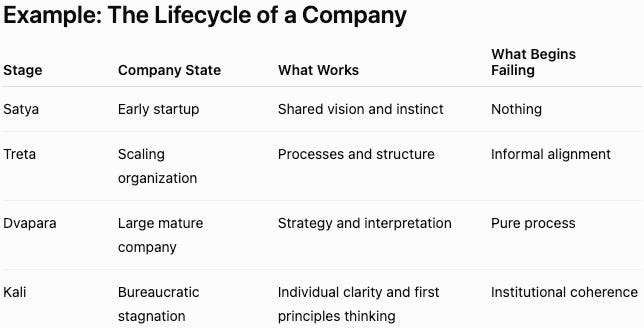
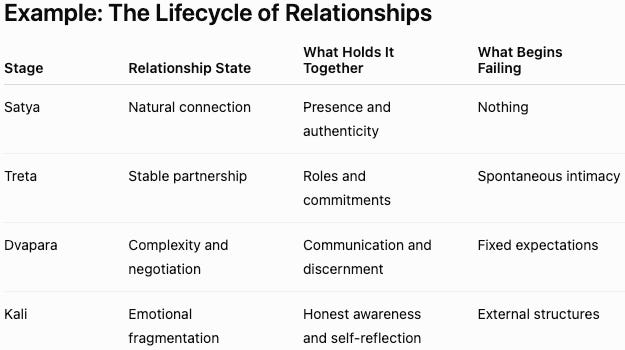
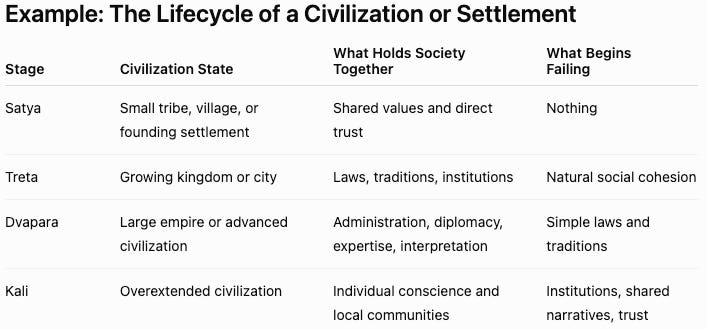
Almost every dynamic system goes through a similar progression. It begins with direct alignment and shared understanding. As it grows, structure becomes necessary. As complexity increases, rules give way to interpretation and strategy. Eventually the original purpose becomes obscured beneath layers of process, bureaucracy, or habit. Renewal only begins when the system reconnects with its original first principles.
This does not mean every company, relationship, or civilization literally passes through the Yugas. Rather, the Yugas offer a useful lens for recognizing the recurring dynamics of growth, decay, and renewal.
Once you begin looking through this lens, you start seeing the same pattern everywhere.